
OEM Jewelry Manufacturing Timelines in Days and Weeks
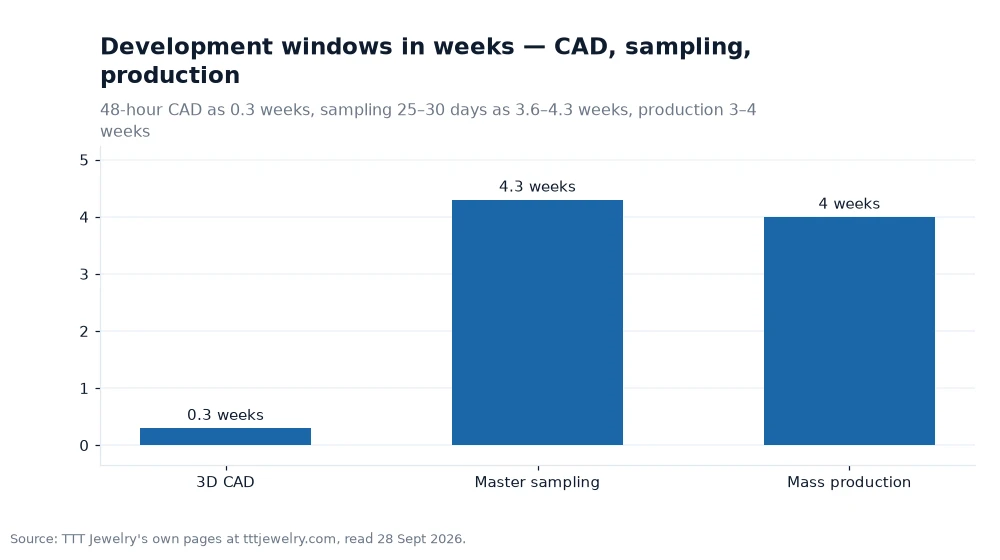
A custom order at TTT Jewelry runs 48–60 days from approved brief to delivery: under 48 hours for 3D CAD, 25–30 days for the master sample and 21–28 days for bulk production. Restated in weeks, that is roughly 7 to 9. The two units are not interchangeable, and calendars built on one while the supplier quotes the other are where launch dates slip.
Key takeaways
- 48 hours of CAD is 2 days, or 6.7–8% of a 25–30 day sampling window.
- Sampling at 25–30 days converts to 3.6–4.3 weeks; bulk at 21–28 days converts to 3–4 weeks.
- The published total is 2 + 25–30 + 21–28 = 48–60 days, about 7 to 9 weeks.
- Six designs released together share one sampling window; six released a week apart queue behind each other.
Why one schedule gets quoted in two units
In an OEM/ODM programme a supplier will describe sampling as 25–30 days and production as 3–4 weeks in the same conversation. Both statements are accurate. Each unit suits the operation it describes: days for sampling, where every bench slot is tracked, and weeks for bulk, where the run is planned as a campaign rather than a list of dates.
Convert them and the rounding shows. A 25-day sample window is 3.6 weeks, a 30-day window is 4.3. Bulk at 3 weeks is 21 days, at 4 weeks 28. A buyer who hears "about a month" for each stage mentally plans eight weeks and lands one to two weeks short of the published worst case.
The practical fix is to keep one calendar in days and convert only when reporting upward. Addition is clean in days: 2 + 25–30 + 21–28 = 48–60. The same sum in weeks runs to fractions and invites rounding in the buyer's favour, which is the direction that costs money.
The 48-hour CAD block is smaller than it looks
3D modelling is quoted at under 48 hours, which is two days. Inside a 25-day sample window that is 48/600 = 8% of elapsed time; inside a 30-day window it is 48/720 = 6.7%. The model is almost never the reason a date moves.
What the block produces is a decision document: a file with wall thickness, stone seats and chain attachments defined precisely enough to cut a mould. ISO 9001:2015 processes matter at this point for a dull reason. The approved model is the reference against which the master is measured, and a version that lives only in an email thread cannot perform that job six weeks later.
The published 48 hours also excludes the buyer's own review. Two days of modelling followed by six days of internal debate is an eight-day CAD stage. The supplier's clock and the project's clock are not the same clock.
Sampling: 25 to 30 days converts to 3.6 to 4.3 weeks
Master physical sampling is the longest single block in the programme. One master is made per design, in the specified metal, with the specified finish and plating, so the piece can be worn, weighed and photographed before bulk metal is committed.
Four operations sit inside the block: the model is grown or cut, the mould is produced, the piece is finished and plated, and stones are set where the design carries them. Any change to one operation resets part of the sequence, which is why the figure is published as a range instead of a date.
Designs can share the range. Six briefs that arrive together send six masters through the same 25–30 days. Six briefs that arrive a week apart send them through a queue. Treating a per-batch window as a per-design cost is the most frequent arithmetic mistake in launch planning, and it inflates a six-piece range to roughly seven months on paper.
Bulk: 3 to 4 weeks, or 21 to 28 days
Once a master is signed off, mass production is quoted at 3–4 weeks, which is 21–28 days. The run reuses the approved mould, repeats the finishing and plating sequence and closes with 100% inspection rather than a sample check.
The block stretches at its edges. Matching colour across plating baths and packing to an approved specification both consume days that already sit inside the window. A buyer asking for a packaging change after the run starts is asking the factory to absorb it from the same 21–28 days, and something else gives.
When comparing suppliers, the useful question is not the headline figure but what sits inside it. A jewelry OEM ODM partner that can describe its mould, plating and inspection sequence is easier to hold to a date than one that quotes a single number and leaves the content undefined.
What the published windows leave out
Three items sit outside 48–60 days. Freight and customs clearance are quoted separately and depend on route and season. Buyer approval time at each gate is excluded, and silence adds day for day. Payment terms can hold a slot as well, because a run usually enters the queue only once the deposit clears.
Counting gates makes the gap visible. There are at least three: CAD approval, master approval and pre-production sign-off. Five working days at each adds 15 days, turning 48–60 into 63–75. That is the honest planning range for a first order with a committee on the buyer's side.
| Stage | Published window | In days | In weeks |
|---|---|---|---|
| 3D CAD modelling | Under 48 hours | 2 | 0.3 |
| Master physical sampling | 25–30 days | 25–30 | 3.6–4.3 |
| Mass production | 3–4 weeks | 21–28 | 3–4 |
| Full development | — | 48–60 | 7–9 |
| Buyer approvals, three gates | Not published | 15 at five days each | 2.1 |
Read the table from the bottom up if a date is already fixed. The approvals row is the only line the buyer controls directly, and it is also the line most often left out of a supplier's quote.
Worked example
Suppose stock has to be on hand by 15 November and the factory quotes mid-range: 28 days for sampling, 25 days for production. Add CAD at 2 days and the total is 2 + 28 + 25 = 55 days.
Count backwards. Fifty-five days before 15 November is 21 September. Now add the buyer's own review, five days at each of three gates, or 15 days. The approved brief must be ready on 6 September, and the brief itself has to be written before that.
Put the fast stage in proportion. Forty-eight hours against a 28-day window is 48/672 = 7.1%. The model occupies one fourteenth of the wait; the master occupies the rest. Any plan that compresses CAD to buy time is optimising the wrong block.
Run the same sum with the two extremes. Fast case: 2 + 25 + 21 = 48 days. Slow case: 2 + 30 + 28 = 60 days. The spread is 12 days, which is why a single promised date without a range is a warning sign rather than a comfort.
Frequently asked questions
How long does OEM jewelry manufacturing take from brief to delivery?
Plan for 48–60 days once the brief is approved: 2 days of CAD, 25–30 days of master sampling and 21–28 days of bulk production. Freight and buyer review time sit outside that figure.
Is the 48-hour CAD figure two working days?
The figure is expressed in elapsed hours, not in working days, so two calendar days is the safer reading. Add your own review time before treating the model as approved.
Can bulk production start before the master sample is approved?
No. The approved master fixes the mould, finish and plating, so the run begins only after written sign-off. Designs within one batch can be sampled in parallel, but each moves to production on its own approval.
Building a calendar that survives contact
Reverse scheduling beats forward scheduling because the delivery date is the only fixed point in the project. Start at the launch, subtract the production block, subtract sampling, subtract CAD, then subtract your own review days. The brief date falls out of the arithmetic rather than out of optimism.
Mixed-metal capsules need a quantity plan alongside the date plan. Silver starts at 50 pieces per design while brass and stainless sit at 100 or more, so a custom jewelry wholesale range built around shared findings will usually schedule better than one assembled from unrelated silhouettes.
Where a shape is likely to return in a second drop, running it first in custom brass jewelry keeps the tooling logic intact when the design later moves to a precious metal.
The published windows are the factory's half of the promise. The other half is a buyer who knows which unit the number is written in and which days belong to whom.
Source note: figures come from the manufacturer's own website (tttjewelry.com), read 28 Sept 2026.[1]