
Allergen Labelling on a Value Line: Four Practical Trade-offs
Every allergen labelling decision on a value line buys one thing and pays for another. Reformulating away a declarable substance buys a shorter ingredient list and costs a development round. Running one global ingredient list buys simplicity and costs flexibility in markets with different thresholds. Buying regulatory support buys certainty and costs margin per SKU. There is no configuration that wins on all four, and the brands that handle this well are the ones that name the trade before the packaging is ordered rather than after.
Key takeaways
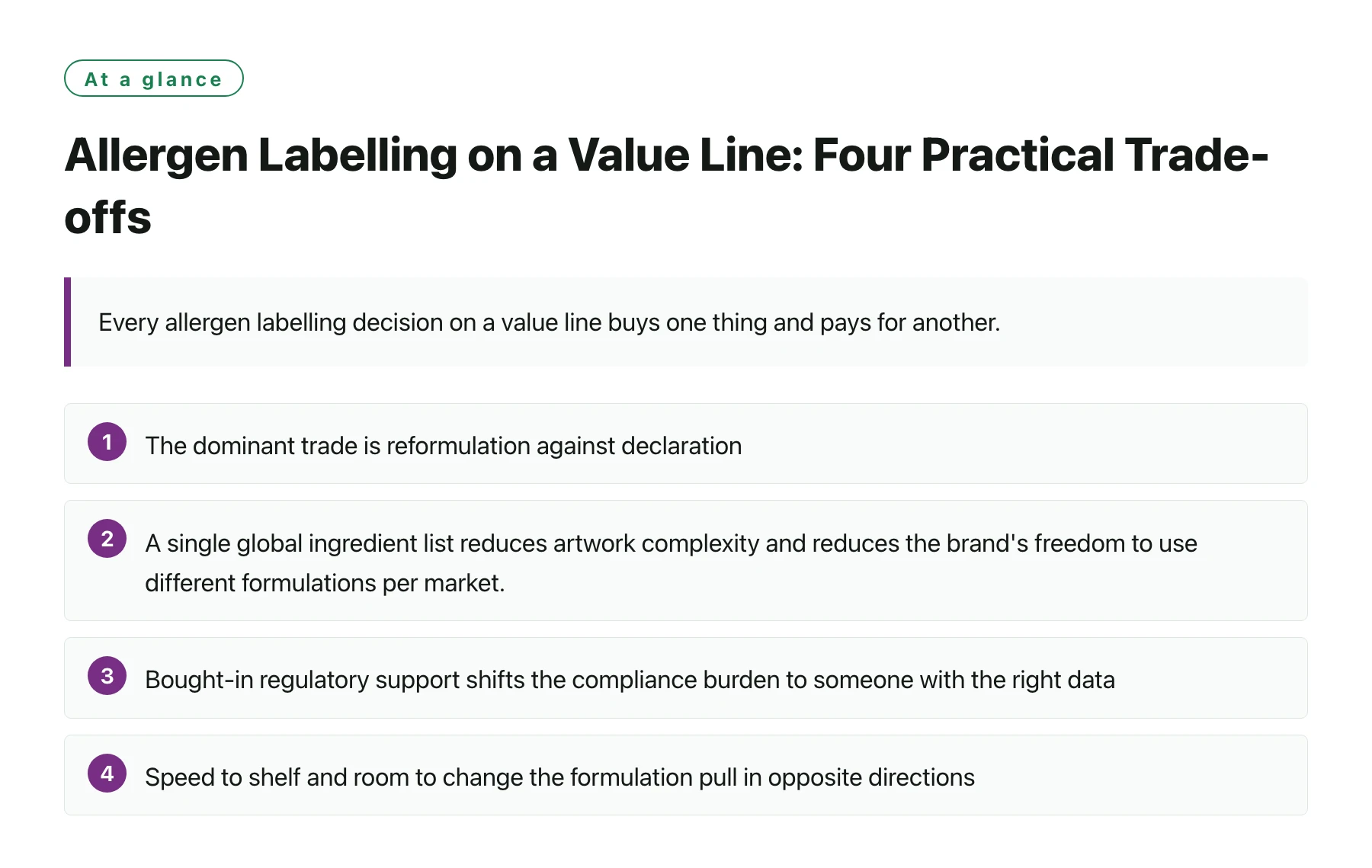
- The dominant trade is reformulation against declaration, and on a value line declaration is usually the cheaper of the two.
- A single global ingredient list reduces artwork complexity and reduces the brand's freedom to use different formulations per market.
- Bought-in regulatory support shifts the compliance burden to someone with the right data, at a cost that scales with the number of SKUs.
- Speed to shelf and room to change the formulation pull in opposite directions, and the calendar usually decides which one wins.
Allergen compliance is often presented as a binary: you either meet the requirement or you do not. In practice it is a series of economic choices about how to meet it, and each choice has a different cost profile depending on volume, market count and how long the product is expected to live on shelf.
The reason value lines feel this pressure more than premium ones is arithmetic. The compliance work is roughly fixed per SKU, while the margin per SKU is smaller, so the same decision consumes a larger share of the contribution. A brand selling at an entry price cannot treat any of these four trades as a rounding error.
The four trades, side by side
| Trade | What it saves | What it costs | When it is the right call |
|---|---|---|---|
| Declare versus reformulate | A shorter ingredient list and a cleaner story for a sensitive-positioned product | A new development round, new stability work and usually a new safety assessment | When the material is also being changed for another reason, or the claim depends on it |
| One global list versus market-specific lists | One artwork version, one print run, one warehouse process | The freedom to formulate separately for each market and to optimise cost per region | When most volume sits in one market and the range is narrow |
| In-house regulatory capacity versus bought-in support | A fixed internal cost and knowledge that stays with the brand | A variable cost per SKU or per market, plus a dependency on the provider's responsiveness | When SKU count is low or the brand has no one who can own the product information file |
| Speed to shelf versus room to change | An earlier launch and less stock held before revenue | Less flexibility if a formula, a threshold or a market rule shifts after printing | When the retail window is genuinely fixed and the range is unlikely to be adjusted |
Read the third column carefully, because it is where the real decision sits. The saving is always visible on a quote; the cost usually appears two quarters later, in a reprint or an unsold pallet.
Trade one: declare it or reformulate it away
This is the trade buyers ask about first, and it is the one most often decided on instinct. Declaring a substance costs a line of small print. Reformulating to remove it costs a development round: new sampling, a new stability assessment, a new safety evaluation and, on some product types, a new set of compatibility tests. On a value line, a development round is often larger than the entire compliance budget.
There are cases where reformulating is still correct. If the product is positioned for sensitive skin, or if a claim depends on the absence of a particular material, then reformulation is a product decision rather than a compliance workaround, and the allergen outcome is a side effect. The mistake is to reformulate purely to shorten a label, which is usually the most expensive way to buy a cosmetic improvement nobody sees.
Whatever route a brand takes, the substance list has to be read accurately. The European Commission's cosmetic ingredient database is the practical reference for how a substance should be named and identified [1], while the fragrance industry's standards library sets out use restrictions that can limit a material regardless of how it is labelled [2]. Those are two different questions and they are worth keeping separate in the brief.
Trade two: one global list or several market lists
Harmonising the ingredient list across every market is attractive because it collapses artwork, print runs and warehouse complexity into one version. For a small brand shipping into two or three countries, that simplification is often worth more than the optimisation it gives up. The cost is that the formulation must satisfy the strictest market it enters, which can mean a more expensive compound everywhere.
The opposite strategy, a separate list per market, trades simplicity for freedom. It suits brands with a dominant market and small volumes elsewhere, and it requires a manufacturer that can produce and label distinct versions without confusing them, which is a common consideration when buyers compare contract perfume manufacturing in China. The European Commission's overview of cosmetics in the EU market is a useful starting point for understanding how requirements are framed at the market level [3], and industry associations publish further practical guidance for companies operating across borders [4].
A middle route, common on value lines, is a single formulation with a market-appropriate declaration. That works when the formulation already sits comfortably on the strict side of the thresholds, and it falls apart the moment a reformulation pushes a material across a line. The trade should therefore be revisited whenever the compound changes, not decided once.
Trade three: build the capability or rent it
Someone has to own the product information file, keep the ingredient list current and answer the market's questions. A brand can hire or train that person, or it can buy the service from a consultant, a laboratory or a manufacturer. Building the capability costs a salary and takes time; renting it costs per SKU, per market and per change, and leaves the brand dependent on someone else's queue.
For a value range with many SKUs and thin margins, the calculation usually favours renting the routine work and keeping one internal person accountable for it. The accountability part is not optional: rented support still needs an owner inside the brand who reads what comes back and notices when a version number moves.
There is a third option that is often overlooked because it does not look like a compliance product: choosing a manufacturing partner whose routine output already includes the documentation. When the same party compounds, fills and labels, the compliance file is part of the production record rather than a separate service, and the per-SKU cost of keeping it current is lower because nobody has to re-collect the data. Reading its background and certifications with that question in mind is more useful than reading them as a badge, and a manufacturer that presents the whole chain in one place, as Xuelei China does, is easier to assess on this point than one that describes only a factory floor.
Trade four: speed to shelf or room to change
Printing packaging early shortens the critical path and reduces the stock a brand has to carry before revenue. It also freezes the declaration at a moment when the formulation may not be final, which on a value line is a real risk because cost-driven changes continue right up to production. The decision is not about being cautious; it is about how likely a change is and how much a reprint would cost.
A workable compromise is to split the packaging. The primary pack, which is usually the expensive tooled item and often carries no ingredient text, can be ordered early, while the carton or label carrying the declaration is the last item to be released. It costs a little schedule discipline and buys back most of the flexibility.
This is also where a clear view of the supply chain helps. A brand that knows which items carry the declaration and who controls the wording can plan the print run around the data rather than around the calendar, and it can hold the declaration release as a formal gate. Buyers who want a wider checklist for that stage can find one in this guide to how to pick a perfume manufacturer, because the allergen question is one part of a larger evaluation.
The trade-off that catches brands most often is the invisible one: they optimise the ingredient list for the product they plan to sell, then discover the market they actually sell most into has a different requirement. Naming the market before the formulation is fixed resolves more allergen trade-offs than any technical fix.
Sources
- EU CosIng — Cosmetic Ingredient Database (European Commission) —— The European Commission's CosIng database of cosmetic ingredients, listing ingredient functions, restrictions and labelling requirements under EU cosmetics law.
- IFRA Standards Library (International Fragrance Association) —— The IFRA Standards Library lists the restrictions the fragrance industry applies to individual fragrance ingredients, based on safety assessments; it is the reference point for compliant fragrance formulation.
- European Commission: Cosmetics in the EU —— The European Commission's overview of EU cosmetics rules, including the responsible person, product information file and safety report requirements.
- Cosmetics Europe —— The European trade association for the cosmetics and personal care industry, publishing guidance, positions and market information.
Frequently asked questions
Is it cheaper to declare a fragrance allergen or to reformulate it away?
Declaring is usually cheaper because it does not disturb the formulation, sampling or safety assessment. Reformulating is justified when the material is being changed for a product reason, such as a sensitive-skin claim, rather than only to shorten a label.
Should a value brand use one ingredient list for every market?
It depends on where the volume sits. One list is simpler and cheaper to print but forces the formulation to satisfy the strictest market. Separate lists cost artwork complexity and require a manufacturer that can keep versions apart reliably.
Do we need a regulatory hire to sell fragrance in the EU?
Not necessarily. Many brands rent the routine work and keep one internal person accountable for the product information file. What cannot be outsourced is the responsibility to notice when the documentation no longer matches the product.
Can packaging be ordered before the allergen declaration is final?
Split the order. Items that carry no ingredient text can be committed early, while the carton or label carrying the declaration should stay unreleased until the position is confirmed. That keeps most of the schedule benefit without freezing the wording early.
Execute institutional-grade signals today.
Join 187,400+ traders using GasProfit to convert volatility into measurable returns — start with a free sign-up or a $250 minimum deposit.